

Know before you go
About Annapurna Region
The Annapurna Region is one of Nepal’s most diverse Himalayan destinations, bringing together high mountains, deep river valleys, forested hills, traditional settlements and dramatically different climatic landscapes within a relatively compact part of the country. For many travellers, Annapurna is first associated with famous journeys such as the Annapurna Circuit or Annapurna Base Camp Trek. Yet these routes represent only part of a much larger region where geography, culture and centuries of movement through the mountains have created many different ways to experience the Himalayas.
At the heart of the region rises the Annapurna massif, a mountain system extending for roughly 55 kilometres. Its highest summit, Annapurna I (8,091 m), is the tenth-highest mountain in the world. The massif also contains Annapurna II, Annapurna III, Annapurna South and numerous other peaks and ridges that form the backdrop to trekking routes throughout the region. Annapurna I also holds an important place in mountaineering history as the first 8,000-metre mountain to be climbed, when a French expedition reached its summit in 1950. Nepal Tourism Board
However, Annapurna's identity cannot be understood through elevation alone. One of the defining qualities of the region is how quickly the environment changes as a journey moves between different sides of the Himalayan range. Trails can begin among cultivated hillsides, villages and subtropical vegetation before entering rhododendron and oak forests and eventually reaching alpine valleys, glaciers and stark high-altitude terrain. North of the main Himalayan barrier, the environment becomes considerably drier, producing the distinctive rain-shadow landscapes associated with areas such as Manang and the trans-Himalayan country beyond. Nepal Tourism Board describes Annapurna as a region of striking contrasts, encompassing some of Nepal's wettest, driest and windiest environments. Trade Nepal
Much of this landscape lies within the Annapurna Conservation Area, Nepal's largest protected area, covering approximately 7,629 square kilometres. The conservation area extends from relatively low elevations to the 8,091-metre summit of Annapurna I, creating an enormous range of ecosystems. NTNC's recent reporting records extensive plant and wildlife diversity within the protected area and describes conservation here as closely connected with the participation and livelihoods of local communities. National Trust for Nature Conservation
This relationship between nature and people is fundamental to travelling through Annapurna. Trekking here is rarely a journey through an empty wilderness. Trails pass through settlements where agriculture, trade, religion, hospitality and everyday mountain life have developed over generations. Different parts of the region are associated with communities including Gurung, Magar and Thakali peoples, while cultural influences change as routes travel north toward higher Himalayan and trans-Himalayan areas. Architecture, food, language, monasteries, shrines, farming patterns and village life therefore change alongside the physical landscape. Trade Nepal
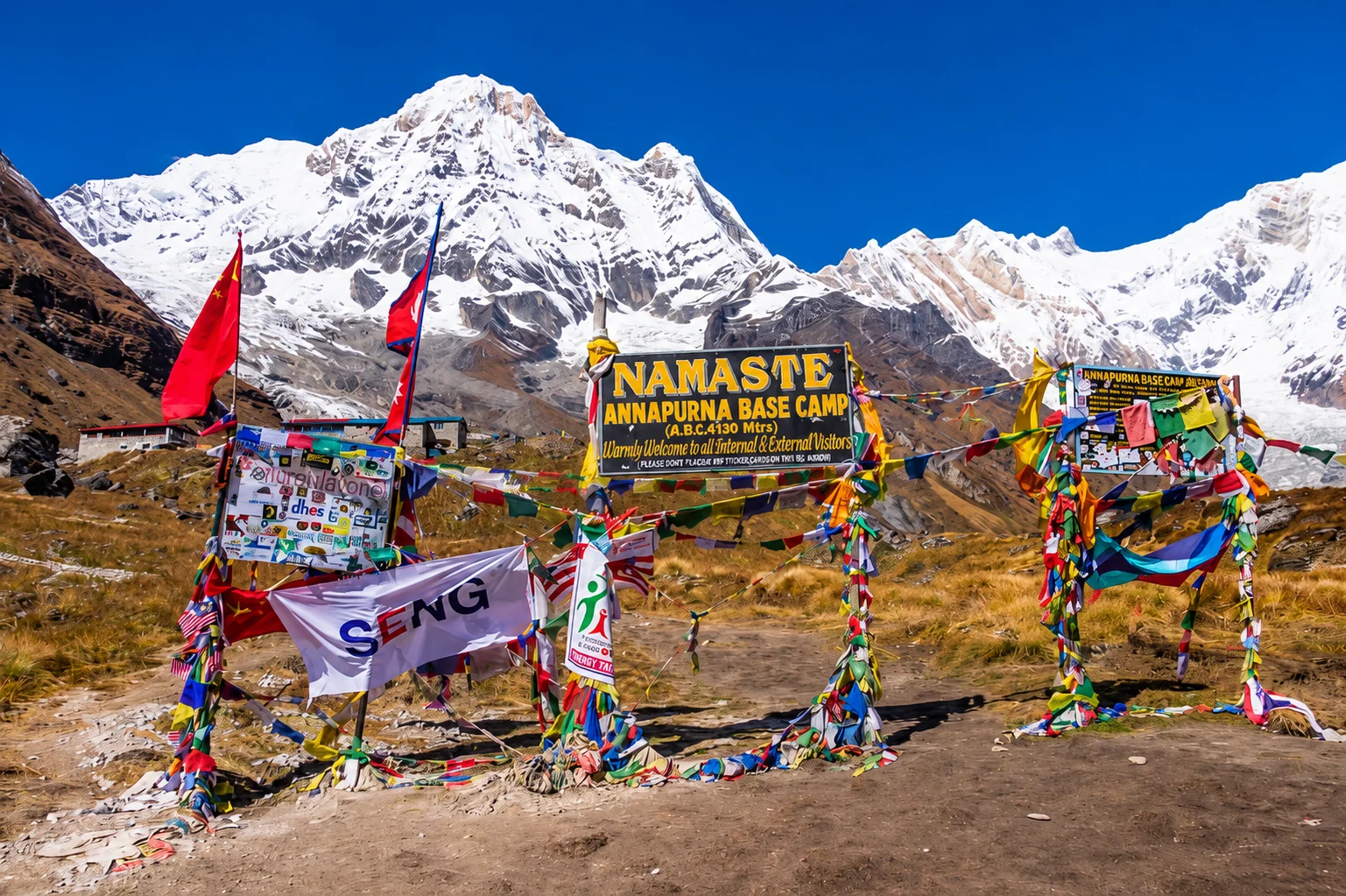
For travellers, this creates a region with several distinct trekking experiences rather than one defining route. The Annapurna Base Camp journey approaches the heart of the massif through the Modi Khola valley before entering Annapurna Sanctuary, where high peaks rise around the upper basin. The experience is quite different from the Annapurna Circuit, which makes a much broader journey around the massif and historically connected valleys on opposite sides of the mountains.
The circuit demonstrates particularly well why Annapurna became internationally known as a trekking destination. Moving around the mountains reveals substantial changes in vegetation, settlement patterns and climate. The route reaches the high Himalayan environment around Thorong La, traditionally one of its defining geographical challenges, before descending toward the Kali Gandaki side of the region. Road development has changed portions of the traditional circuit over time, but the wider landscape still allows itineraries to be designed around trails, villages and side journeys rather than simply following one fixed historical route. Nepal Tourism Board identifies Thorong La at 5,416 metres and highlights the changing scenery as one of the circuit's defining characteristics. Trade Nepal
Annapurna also provides considerably shorter Himalayan experiences. Trails around Ghandruk, Ghorepani and the lower Annapurna foothills combine mountain panoramas with forests and established villages, making them suitable for travellers who cannot commit to a long expedition-style itinerary. Other journeys such as Mardi Himal move toward higher ridges and close mountain viewpoints within a comparatively shorter trekking schedule. Nepal Tourism Board specifically notes that the region accommodates journeys ranging from short treks of only a few days to multi-week routes. Nepal Tourism Board
This variety is strategically important when thinking about the Annapurna Region as a whole. There is no single “Annapurna trek.” A first-time visitor might want a comfortable village-based journey with Himalayan views, while another traveller may want to reach a high mountain sanctuary. Someone with more time may prefer a long circuit involving substantial altitude gain, and experienced trekkers may look for quieter extensions or less-travelled trails away from the busiest corridors. The region allows these different experiences to coexist without losing its geographical identity.
Pokhara plays an important role in this network. Situated south of the Annapurna Himalaya, the city serves as the principal tourism gateway for many treks in the region. Its road and air connections with Kathmandu and its proximity to several trail approaches make it a natural staging point before and after many Annapurna journeys. However, not every trek begins from the same place. Routes around the eastern and northern sides of the massif use different access corridors, which is why the exact transport plan should always follow the itinerary rather than treating Pokhara as the literal trailhead for every Annapurna trek. NTB identifies Pokhara as the principal departure point for numerous Annapurna journeys. Trade Nepal
Another major geographical feature of the wider landscape is the Kali Gandaki valley, which separates the Annapurna massif from Dhaulagiri to the west. The river corridor has long provided movement through an otherwise formidable mountain environment and contributes to the striking transition between greener southern landscapes and the drier country farther north. Along these routes, natural geography and historic human movement are closely intertwined. Nepal Tourism Board
The forests and protected landscapes also make Annapurna more than a collection of mountain viewpoints. Rhododendrons and orchids occur within the conservation area, while its wildlife includes Himalayan species adapted to environments ranging from forests to high alpine country. NTB lists blue sheep and the endangered snow leopard among the mammals found within the protected area, alongside a substantial diversity of birdlife. Nepal Tourism Board
For Himalayan Trek Ventures, the value of the Annapurna Region lies precisely in this diversity. We do not need to present every traveller with the same route simply because it is famous. The region can support short introductions to Himalayan trekking, culturally rich village journeys, classic base-camp routes, longer circuits and more demanding high-altitude adventures. Choosing between them should depend on available time, trekking experience, preferred landscapes, season and how deeply someone wants to travel through the region.
It is also worth looking beyond the names that dominate trekking itineraries. Some of Annapurna's most memorable moments happen between the headline destinations: walking through a village early in the morning, seeing cultivated terraces give way to forest, sharing a trail used by local residents, hearing prayer flags moving above a mountain settlement, or watching the character of the landscape change as altitude increases. These transitions give a trek context and help explain why Annapurna has remained important even as roads, accommodation and travel patterns have evolved.
That combination of accessibility and depth is perhaps Annapurna's greatest strength. The region is developed enough to support a wide range of travellers, yet geographically large and varied enough that the experience does not have to be limited to the most familiar trail. Famous routes provide an introduction, while side valleys, villages, ridges and longer combinations create opportunities to experience a quieter side of the region.
For travellers deciding where to trek in Nepal, Annapurna therefore offers something broader than a checklist of famous viewpoints. It is a region where Himalayan scale can be experienced alongside living communities; where a journey can move from fertile hills to stark high-altitude country; and where the trail can be adapted to very different levels of time and ambition. Whether the journey leads toward Annapurna Base Camp, around the massif, onto a high ridge or through the lower mountain villages, the defining experience is the changing relationship between landscape, altitude, culture and life in the Himalayas.
That is what makes the Annapurna Region worth exploring beyond a single famous trek.