

Know before you go
About Trekking in Nepal
Trekking in Nepal → Editorial Content → Overview
Trekking in Nepal is one of the most rewarding ways to experience the Himalayas. Trails extend from forested foothills and traditional mountain villages to high passes, glacial valleys and base camps beneath some of the highest mountains on Earth. Yet the experience is about much more than reaching a famous viewpoint. A trek creates time to move gradually through Nepal’s landscapes, meet communities along the trail and experience how geography, culture and everyday mountain life change with altitude.
Nepal offers an unusually wide range of trekking experiences. Travellers can walk established teahouse trails in the Everest and Annapurna regions, explore culturally rich valleys in Langtang and Manaslu, journey through the trans-Himalayan landscapes of Mustang and Dolpo, or travel farther into remote regions such as Kanchenjunga, Makalu, Humla, Dhaulagiri, Rolwaling and Far Western Nepal.
Some journeys can be completed within a week. Others require two or three weeks—or considerably longer. Some remain below extreme elevations, while high-altitude routes cross passes above 5,000 metres. This variety makes trekking in Nepal suitable for many different travellers, provided the route is matched carefully to their fitness, experience, available time and expectations.
More Than Everest Base Camp
For many international travellers, trekking in Nepal is immediately associated with Everest Base Camp. The journey through the Khumbu deserves its reputation, combining immense Himalayan scenery with Sherpa communities, Buddhist monasteries and one of the world's most recognizable mountain landscapes.
But Everest represents only one part of Nepal's trekking geography.
The Annapurna Region offers an extraordinary variety of routes. Travellers can walk through Gurung and other mountain communities toward Annapurna Base Camp, undertake the longer Annapurna Circuit, or choose shorter journeys through forested hills and mountain villages.
Manaslu provides a quieter high-altitude circuit through the Budhi Gandaki Valley toward Larkya La, while Langtang combines accessible Himalayan trekking with Tamang heritage, alpine valleys and journeys toward Kyanjin Gompa and Gosainkunda.
Beyond these established regions, the character of trekking changes again.
Mustang introduces dry trans-Himalayan landscapes and ancient settlements. Dolpo and Humla offer long journeys through remote northwestern Nepal. Kanchenjunga and Makalu lead into the isolated eastern Himalaya, while Rolwaling provides secluded valleys and more adventurous high-mountain possibilities.
Farther west, routes around Api and Saipal demonstrate just how much of Nepal remains beyond the country's familiar trekking circuit.
Trekking Through Changing Landscapes
One of the defining features of trekking in Nepal is the remarkable environmental variation encountered over relatively short geographical distances.
A journey can begin among terraced farmland, subtropical vegetation and river valleys before climbing through oak, pine and rhododendron forests. Higher still, trees gradually disappear and the landscape opens into alpine meadows, rocky valleys, moraine and glaciers.
On some routes, the change continues into dry trans-Himalayan landscapes lying beyond the main influence of the summer monsoon.
This progression is part of what makes walking through Nepal different from simply travelling between viewpoints by vehicle.
The landscape changes slowly enough to be experienced.
Temperature, vegetation, architecture and livelihoods can all shift as the trail climbs. Travellers begin to understand how elevation influences both the natural environment and the communities living within it.
Mountain Communities and Culture
Nepal's trekking trails pass through culturally diverse landscapes.
Depending on the region, travellers may encounter Sherpa, Tamang, Gurung, Magar, Thakali, Rai, Limbu and numerous other communities, each with their own histories, languages, traditions and relationships with the mountains.
Buddhist monasteries, Hindu shrines, mani walls, prayer flags, chortens and local festivals may form part of the cultural landscape, but traditions differ considerably between regions.
Trekking should therefore not present Nepal as though the entire Himalaya has one uniform "mountain culture."
A journey through Khumbu is culturally different from travelling through Mustang, Manaslu, Kanchenjunga or Far Western Nepal.
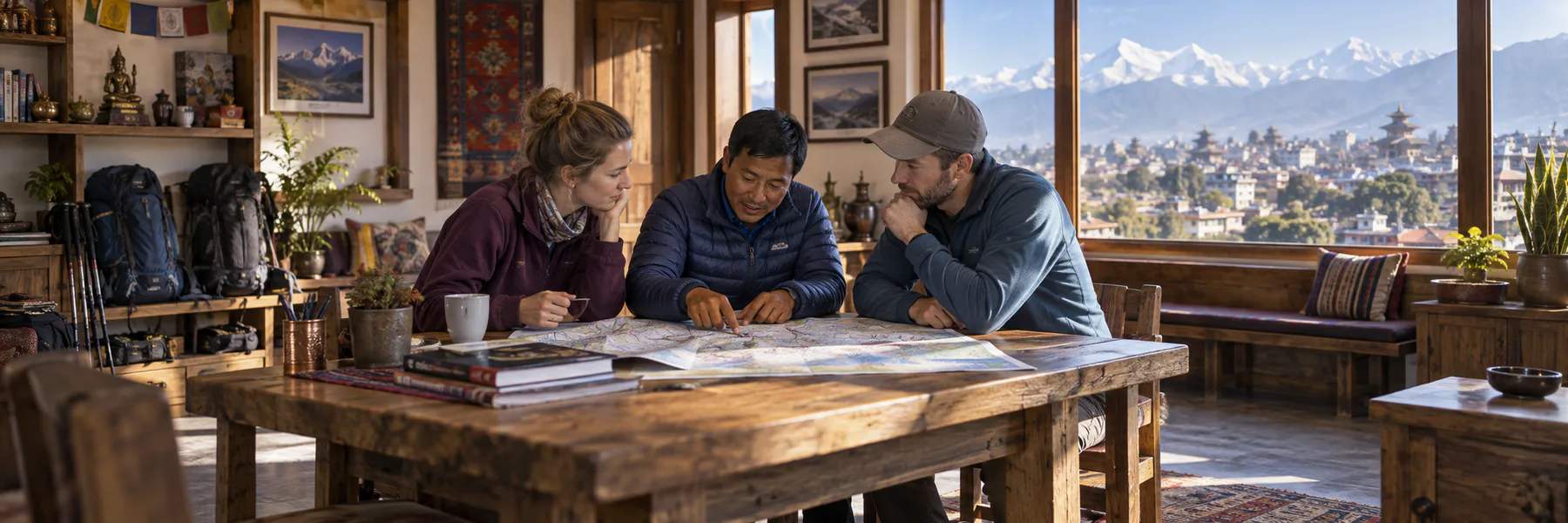
At Himalayan Trek Ventures, these differences should form part of the experience. Guides can help travellers understand the places they pass through rather than simply leading them from one lodge to another.
Respect is essential.
Visitors should follow local customs, ask before photographing people and behave appropriately around monasteries, temples and sacred places.
Teahouse Trekking in Nepal
One of Nepal's distinctive trekking traditions is the extensive network of teahouses and mountain lodges found along many established routes.
Instead of carrying full camping equipment, travellers can stay in locally operated accommodation and eat meals along the trail.
Everest, Annapurna, Langtang and parts of Manaslu have particularly established lodge networks.
Facilities vary greatly.
Some popular settlements offer comfortable rooms, cafés, charging facilities and internet access. Remote areas may provide only simple rooms, basic meals and limited electricity or hot water.
Travellers should therefore avoid assuming that every Nepal trek provides the same standard of accommodation.
In more isolated regions—including sections of Dolpo, Humla, Dhaulagiri, Kanchenjunga, Makalu and Far Western Nepal—additional logistical or camping support may sometimes be appropriate depending on the exact route.
High-Altitude Trekking
Many of Nepal's famous journeys enter high-altitude environments, making acclimatization one of the most important elements of itinerary design.
Travellers commonly focus on physical fitness when preparing for a trek. Fitness certainly helps with long walking days, but it does not prevent altitude illness.
The body needs time to adapt as elevation increases.
A thoughtfully designed itinerary therefore considers more than the shortest possible route between two places. Gradual ascent, suitable overnight elevations and acclimatization opportunities can be more important than reducing the itinerary by one or two days.
This is particularly relevant for journeys involving Everest Base Camp, high passes, Manaslu, Makalu, Kanchenjunga and other sustained high-altitude routes.
At Himalayan Trek Ventures, thoughtful pacing should remain one of the principles behind our trekking itineraries.
Reaching a destination matters, but reaching it responsibly matters more.
Choosing the Right Trek
There is no single "best trek in Nepal" for every traveller.
A suitable journey depends on several factors:
Available time – Trekking holidays can range from short mountain journeys to expeditions lasting several weeks.
Fitness – Long ascents, descents and consecutive walking days can be physically demanding even at moderate elevations.
Maximum altitude – A trek crossing a 5,000-metre pass requires different preparation from a lower-altitude village trek.
Previous experience – Some remote or technically demanding routes are better suited to experienced trekkers.
Season – Snow, rainfall and temperature can dramatically change trail conditions.
Accommodation expectations – Popular routes usually provide stronger lodge infrastructure than remote regions.
Interest – Some travellers prioritize mountains, while others value culture, wildlife, photography, monasteries, quieter trails or remote communities.
Choosing according to these factors creates a much better experience than selecting a trek simply because it is the most famous.
When to Trek in Nepal
The principal trekking seasons are generally spring and autumn.
Spring, from March to May, brings gradually warmer temperatures, flowering vegetation at many lower and middle elevations and generally suitable conditions for numerous Himalayan routes.
Autumn, particularly from late September through November, is another major trekking period. Following the summer monsoon, conditions often become clearer and drier, providing excellent Himalayan visibility.
However, Nepal should not be treated as though every region follows exactly the same seasonal pattern.
The trans-Himalayan environments of Upper Mustang and parts of Dolpo, for example, can provide possibilities during periods when monsoon rain affects many other trekking regions.
Winter can work for selected lower-altitude journeys, while high passes may become difficult or inaccessible because of snow and extreme cold.
The best season should therefore be determined by the specific trek, not simply by a generic Nepal calendar.
Trekking Permits and Regulations
Permit requirements vary according to the route.
A trek may enter a national park or conservation area, requiring the relevant entry permit. Certain areas near Nepal's international borders are designated as restricted trekking areas and require additional permits and regulated arrangements.
Requirements can also change.
For that reason, individual HTV Trip pages should provide the current permit information for the specific itinerary rather than repeating one generic permit list across every Nepal trek.
This Activity page should help travellers understand the system broadly, while the individual trek page provides the exact requirements.
Responsible Trekking
Nepal's mountain environment is both spectacular and fragile.
Increasing trekking activity can create pressure through waste, plastic consumption, water use and demand for fuel and other resources.
Travellers can reduce their impact by carrying reusable bottles, minimizing unnecessary packaging, managing waste properly and respecting protected-area regulations.
Responsible trekking also has a social dimension.
Using locally operated accommodation, respecting cultural customs and ensuring guides and support staff are treated professionally all contribute to a healthier trekking economy.
For HTV, responsible tourism should not exist only as a marketing phrase. It should influence how journeys are designed and operated.
Guided Trekking and Local Knowledge
A knowledgeable guide contributes much more than navigation.
Guides help interpret the landscape, communicate with communities, coordinate accommodation, respond to changing trail conditions and recognize potential problems during the journey.
In remote regions, local knowledge becomes even more valuable because transportation, accommodation and trail conditions can change.
For international travellers, trekking with an experienced Nepal-based team also creates opportunities to understand the country beyond what can be learned from an itinerary.
HTV's role should therefore be to help travellers experience Nepal rather than simply transport them between destinations.
Finding Your Journey Through Nepal
The extraordinary strength of trekking in Nepal is choice.
A first-time trekker may begin with a comfortable lodge-based journey through the Annapurna foothills. Another traveller may dream of standing beneath Everest. Experienced trekkers might prefer Manaslu, Kanchenjunga or Makalu, while those searching for quieter cultural landscapes may be drawn toward Mustang, Dolpo, Humla or the far west.
Each journey reveals a different Nepal.
The mountains change. Languages and communities change. Architecture changes. Food, vegetation, climate and trail conditions change.
What connects these experiences is the act of travelling slowly through the landscape.
For Himalayan Trek Ventures, trekking should therefore mean more than collecting famous destinations. It means creating journeys with enough time to walk, acclimatize, understand the places along the trail and experience Nepal beyond the view.
Whether the trail leads toward an iconic base camp, across a high Himalayan pass or into a valley rarely visited by international travellers, trekking offers something that faster forms of travel rarely provide: the opportunity to watch Nepal unfold one step at a time.