
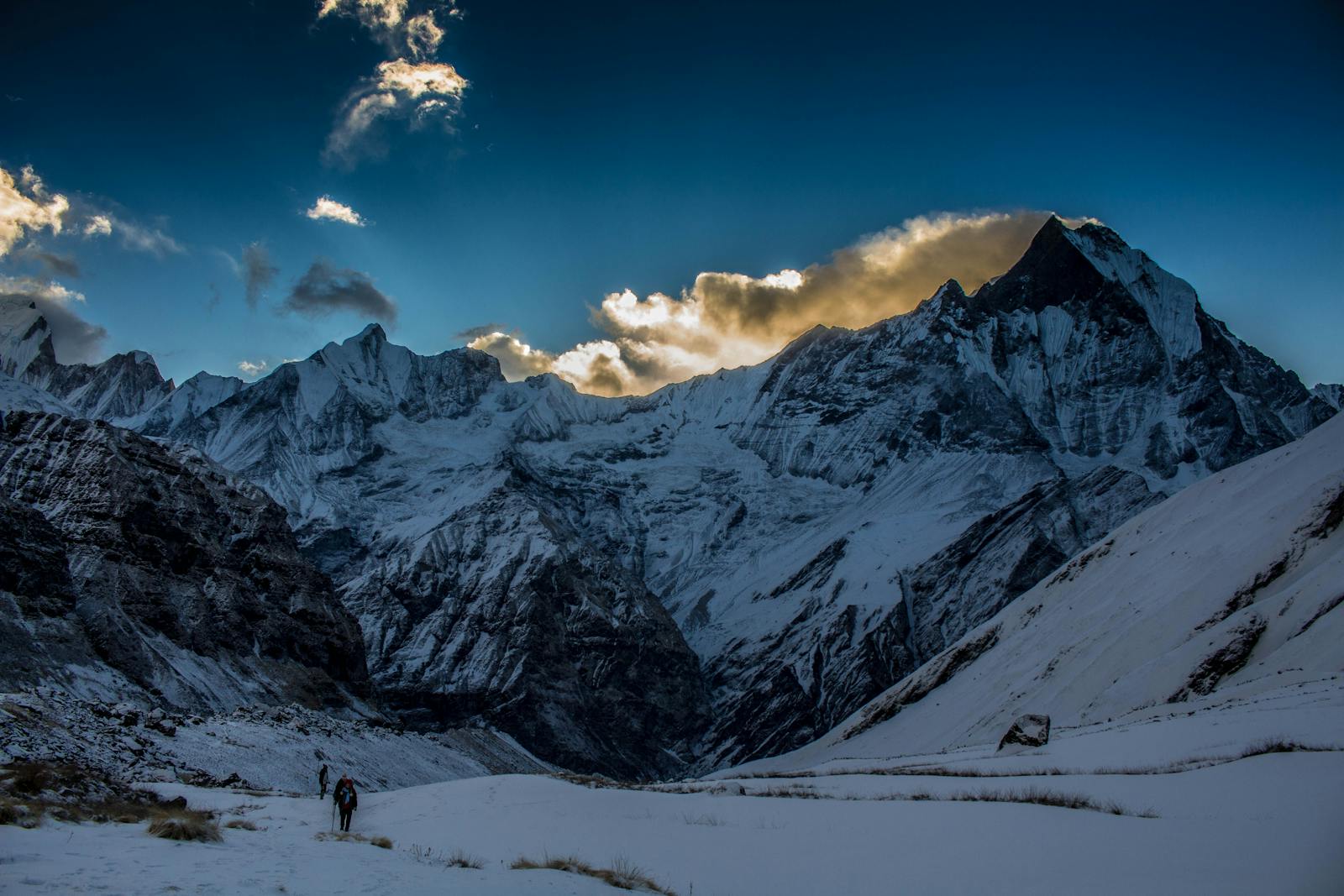
Short Annapurna Base Camp Trek – 7 Days
USD 749
7 Days
Moderate
4,130 meters
Teahouses/Lodges
Bus
2-6
March
Highlights
- Reach Annapurna Base Camp at 4,130 meters within a compact 7-day itinerary
- Follow the classic route via Chhomrong, Dovan, Deurali, and Machapuchare Base Camp
- Experience rapid altitude gain balanced by an immediate descent after the summit day
- Walk through bamboo forests, rhododendron zones, and high alpine terrain
- Stay in traditional teahouses with hot meals available every day
- No camping or technical climbing skills required
- Trek alongside the glacier-fed Modi Khola valley
- Enjoy sunrise and sunset views inside the Annapurna Sanctuary
- Designed for travellers with limited time but good fitness
- Includes the longest descent day for faster altitude recovery
- Best suited for autumn and spring weather windows
- Permits and logisticsare handled entirely before the trek begins
Short Annapurna Base Camp Trek – 7 Days Introduction
Wanna go on a short trek to Nepal’s Himalaya that reaches up to 4,130 m within a single, continuous itinerary? Then, the 7-day Annapurna Base Camp Trek is designed for folks like you.
This short Annapurna Base Camp trek runs for 6 nights and 7 days, starting with a 3-hour drive from Pokhara to Nayapul or Samrung Danda (1,070-1,100 m) and finishing back in Pokhara via Jhinu Danda. Over 65-75 km, you walk 5-7 hours per day, climbing steadily through villages like Upper Sinuwa (2,320 m), Deurali (3,230-3,700 m), and Machapuchare Base Camp at 3,700 m.
Then, finally, you will reach the highest point, Annapurna Base Camp at 4,130 m. And guess what, you will be surrounded by the snowy giants of the Annapurna Region like Annapurna I, Hiunchuli, and Machapuchare.
Furthermore, this 7-day ABC trek is considered moderate, with stone staircases and sustained ascents but no technical climbing. It works because the route is optimized. Additionally, we were only able to design this itinerary by compressing the rest days. So, if you are an absolute beginner, we advise you to choose a much longer classic Annapurna Base Camp trek.
Why Choose the Short Annapurna Base Camp Trek?
Allocating time in this busy life is actually really hard, which is why the short Annapurna Base Camp trek is designed for trekkers who want the full ABC experience in 7 days, not 14 days.
Now, how can we possibly do that since the destination is actually the same? Well, we managed to do it by reducing total trekking days through road access to Jhinu Danda or Samrung Danda, saving 1–2 approach days. In addition, as mentioned, we also cut the rest days, which allowed us to cut another 2-3 days.
However, you will still have to spend 6-7 hours daily while trekking in the Annapurna region. And this also means that we will get all the magical views of Annapurna Sanctuary while spending less time in the valley.
Talking about the route, it is direct and efficient. You reach Machapuchare Base Camp (3,700 m) and ABC without visiting Poon Hill. This keeps attention on glaciers, peaks, and the sanctuary bowl itself.
Who Should Go on the Short Annapurna Base Camp Trek?
Now, can a beginner complete ABC in 7 days? The short answer is no, without rest days, they can’t, as without the rest days, they might be more prone to altitude risks.
This trek is designed for trekkers who already know how their bodies respond to long mountain days. Besides that, you have to reach 4,130 m in 7 days, with 6–8 hours of walking per day, so readiness matters more than enthusiasm.
This trek is a good fit if you are:
- An experienced trekker who has completed 5+ consecutive trekking days before
- Someone with prior altitude exposure above 3,000–3,500 m in the last 12–24 months
- Physically fit enough for 6–7 hours of daily walking on stone steps and steep trails
- Comfortable with rapid elevation gain of 800–1,000 m on ascent days
- Confident managing fatigue during long descents, including 2,000 m downhill from ABC
This trek is not ideal if you are:
- A first-time trekker with no multi-day hiking experience
- New to altitude and unable to train for 2–3 months beforehand
- Managing untreated knee, heart, or respiratory conditions
- Looking for a slow, highly acclimatized trekking pace
For trekkers with the right background, this 7-day Annapurna Base Camp trek feels efficient, focused, and complete.
How Himalayan Trek Ventures Keeps You Safe for the 7-Day Annapurna Base Camp Trek?
On a short ABC schedule, safety matters because the days are naturally fuller and the altitude comes faster. Our focus is on keeping the trek calm and controlled, not “fast.”
We do three simple things consistently:
First, our guides pace the group conservatively above 3,000 m, with regular water and breathing breaks. Second, we monitor how you’re adjusting day by day (symptoms first, numbers second), and we’re comfortable changing the plan if someone isn’t adapting well. Third, we keep communication reliable so decisions aren’t delayed when weather or health shifts.
The trail is not technical, but it is real mountain terrain. When the systems are steady, you feel it: less worry, better sleep, and more space to enjoy reaching Annapurna Base Camp (4,130 m).
By doing these things consistently, we give our absolute best to keep you safe in this journey.
Outline Itinerary
- Day 1: Drive from Pokhara to Siwai (approx. 2.5 hrs), trek to Chhomrong (2,170m)
- Day 2: Trek from Chhomrong to Dovan (2,600m)
- Day 3: Dovan to Deurali (3,200m)
- Day 4: Deurali to Annapurna Base Camp (4,130m) through Machapuchare Base Camp (3,700m)
- Day 5: Descent from ABC to Bamboo (2,310m)
- Day 6: Trek from Bamboo to Jhinu Danda (1,780m)
- Day 7: Trek to Siwai, drive back to Pokhara
Detailed Itinerary
Day 1: Drive from Pokhara to Siwai (approx. 2.5 hrs), trek to Chhomrong (2,170m)
The trek begins quietly, with a long road journey before your legs even start working. From Pokhara (822 m), you drive for 3–4 hours covering roughly 55–65 km toward Siwai / Jhinu Danda (1,710–1,780 m), the roadhead of the short Annapurna Base Camp trek. In fact, the final stretch is slow, rough, and uneven, requiring a 4WD jeep, especially outside the dry season.
The road climbs steadily through terraced farmland, small villages, and narrow mountain tracks. On clear mornings, Machapuchare (6,997 m) briefly appears above the green hills, reminding you why this effort matters. Still, this is a transit day, not a sightseeing drive.
After lunch at Jhinu Danda, the walk begins.
The trail to Chhomrong (2,170 m) is only about 6 km, but it takes 4–5 hours due to continuous climbing. Within 20–30 minutes, you cross a long suspension bridge over the Modi Khola, a glacial river flowing down from the Annapurna Sanctuary.
From here, the path turns serious. Stone steps climb relentlessly through oak and rhododendron forest between 1,800–2,100 m, passing Nayagaon / Bhunuwa before the final ascent. The last section into Chhomrong includes 800–1,200 stone steps, often the toughest part of the day.
You reach Chhomrong by late afternoon, tired but settled.
This day feels demanding not because of altitude, but because effort starts immediately. Pace yourself. Tomorrow climbs higher.
Day 2: Trek from Chhomrong to Dovan (2,600m)
| Key points | Details |
| Start / End | Chhomrong (2,170 m) to Dovan (2,520 m) |
| Distance | 8.6 to 10 km |
| Walking time | 5 to 6 hours |
| Elevation gain | 350 to 430 m |
| Major landmarks | Chhomrong Khola, Sinuwa, Bamboo, Modi Khola |
On day 2, morning feels calm in Chhomrong, but the legs notice the plan quickly. You start at 2,170 m, drop fast, then climb back higher. In fact, it is a pattern that you will see through out the day.
From Chhomrong, you walk down steep stone steps for roughly 150-200 meters before reaching the Chhomrong Khola suspension bridge (1,950 m). After the bridge, the direction changes and the path climbs steadily toward Sinuwa (2,360 m), gaining roughly 200 m in shaded forest over 1.5-2 hours.
Beyond Upper Sinuwa, the forest thickens. Bamboo begins to close in, light softens, and humidity rises. This stretch toward Bamboo village (2,310 m) feels cooler but slower, even though the altitude barely changes. From here, the trail follows the western bank of the Modi Khola, with glacier-fed water audible below.
The final section climbs gently into Dovan (2,520 m). Total walking time stays around 5-6 hours across 8.6-10 km, with a net gain of just 350-430 m ; yet fatigue is real because of the early descent and long forest climb. Take this day slowly. Eat well, hydrate often, and let your body adjust ; tonight’s sleep at 2,520 m quietly prepares you for higher ground ahead.
Day 3: Dovan to Deurali (3,200m)
| Key points | Details |
| Start / End | Dovan (2,520 m) to Deurali (3,200 m) |
| Distance | 6 to 7 km |
| Walking time | 5 to 6 hours |
| Elevation gain | 600 to 700 m |
| Major landmarks | Himalaya Hotel, Hinku Cave, Modi Khola gorge |
Day 3 is the climb that changes the mood of the trek. You leave Dovan in the Modi Khola valley and start gaining height almost immediately. The trail stays close to the river at first, with that milky, glacier-fed water sound in the background, but the valley begins to feel narrower and quieter as you go higher.
Most groups take a short break around Himalaya (often a lunch stop), then continue upward through darker, denser sections where bamboo and rhododendron mix. After that, the forest slowly opens. There are more rocks underfoot, fewer tall trees, and the air feels noticeably cooler.
Hinku Cave is a common waypoint to pause, drink, and reset your pace. Nothing rushed here. Small steps work better than speed.
By the time you reach Deurali (about 3,200 m), you can feel you’re entering the high part of the sanctuary. It’s a natural transition point. So you need to rest, eat well, and let your body settle for the alpine zone ahead.
Day 4: Deurali to Annapurna Base Camp (4,130m) through Machapuchare Base Camp (3,700m)
| Key points | Details |
| Start / End | Deurali (3,200 m) to Annapurna Base Camp (4,130 m) |
| Distance | 8-9 km |
| Walking time | 4-5 hours |
| Elevation gain | 930 m |
| Major landmarks | Bagar, Modi Khola bridge, Machapuchare Base Camp |
The day begins quietly. Leaving Deurali, the trail rises into open alpine ground where trees thin out, and the valley widens. Footing is rocky and uneven, with cold air and silence replacing the forest sounds of earlier days.
Within the first hour, the trail reaches Bagar, a quiet spot where small streams meet, and just below that you will find Modi Khola flowing at it’s natural pace.
Beyond Bagar, the route crosses a single bridge over the Modi Khola. This crossing marks a clear shift in scale. The mountains feel closer and the walls of the sanctuary begin to surround you. From here, the climb toward Machapuchare Base Camp is steady but short, made harder by altitude rather than distance.
Machapuchare Base Camp (3,700 m) is a natural pause. The sacred peak rises directly overhead, and many trekkers feel the first real effects of thin air here.
After rest and a light meal, the final stretch to Annapurna Base Camp follows a gentle, exposed trail across moraine and open ground.
And finally, after 4 to 5 hours of walking, you will finally reach Annapurna Base Camp, which means you reached the summit of this trip.
Day 5: Descent from ABC to Bamboo (2,310m)
| Key points | Details |
| Start / End | ABC (4,130 m) to Bamboo (2,310 m) |
| Distance | 13-15 km |
| Walking time | 7-8 hours |
| Elevation loss | 1,820 m |
| Major landmarks | MBC, Deurali, Himalaya Hotel, Dovan, Modi Khola |
Day 5 is long. It’s mostly downhill. Your lungs feel better, but your knees do more work.
You leave ABC early and drop back to Machapuchare Base Camp, then continue down toward Deurali. The first hours are rocky and exposed, and then the trail slowly re-enters the forest. As you lose altitude, the air feels thicker and warmer, and you’ll start removing layers.
From Deurali to the Himalaya Hotel, the descent is steep in sections, with many steps that can tire your thighs. Most groups stop at the Himalaya Hotel for lunch and a longer rest because the day is not “half done” yet.
After lunch, the path continues down past Dovan and deeper into the bamboo zone. The forest becomes dense, shaded, and humid, and the Modi Khola is a constant sound nearby. By the time you reach Bamboo (2,310 m), it feels like a full exit from the high alpine world; still tired, but lighter.
Day 6: Trek from Bamboo to Jhinu Danda (1,780m)
| Key points | Details |
| Start / End | Bamboo (2,310 m) → Jhinu Danda (1,780 m) |
| Distance | 9-10 km |
| Walking time | 5-6 hours |
| Elevation change | 530 m descent |
| Major landmarks | Dovan, Chhomrong Khola, Chhomrong village |
| Overnight | Jhinu Danda |
Day 6 is steady and measured, allowing the body to settle after the long descent from base camp. The trail leaves Bamboo through shaded forest, following familiar ground alongside the Modi Khola before reaching Dovan. From here, the path gradually descends toward the Chhomrong Khola.
A defining moment of the day is the steep descent to the Chhomrong Khola suspension bridge, followed immediately by a sustained climb back up to Chhomrong village. This section tests tired legs, even though altitude stress is now minimal. After Chhomrong, the trail descends gently through terraced hillsides toward Jhinu Danda.
Jhinu Danda sits lower, warmer, and greener than the previous nights. Many trekkers choose to visit the nearby natural hot springs in the afternoon, easing muscle soreness and marking a clear psychological shift from high-mountain focus to recovery and relaxation.
Day 7: Trek to Siwai, drive back to Pokhara
| Key points | Details |
| Start / End | Jhinu Danda (1,780 m) → Siwai → Pokhara |
| Distance | 5-6 km trek |
| Walking time | 2-3 hours |
| Elevation change | 600 m descent |
| Major landmarks | Modi Khola, Siwai roadhead |
| Drive time | 3-4 hours |
The final day is short and unhurried. The trail descends gently from Jhinu Danda, crossing the Modi Khola and passing through small villages and farmland before reaching Siwai.
At Siwai, the trek officially ends. The drive back to Pokhara follows river valleys and rural roads, gradually reconnecting with urban life. By afternoon, the mountains recede behind you, bringing the journey to a calm and complete close.
Includes
Tourist Bus Kathmandu to Pokhara (one way)
- An air-conditioned tourist coach ride from Kathmandu to Pokhara. Plenty of room on the coach with big windows. Relaxing breaks will break up the ride while you appreciate the terraced hills and rivers as you travel the winding road to Pokhara.
Private Transfers to/from Trek Starting Point
- Private transfers in a vehicle from Pokhara to Nayapul (where the trek starts) and from Jhinu back to Pokhara. No crowds or waiting – just smooth transitions that make things as easy as possible.
2 Nights in Pokhara (hotels)
- You will be staying in a quaint lakeside hotel (twin/double sharing) before and after the trek. Clean hot showers and soft bedding, with views of calm waters and snow-capped peaks in the distance each morning.
4 Nights in Mountain Lodges (tea houses)
- Simple and genuine Himalayan hospitality, you will find at the tea houses and lodges we selected for you to stay during the trek. Basic accommodation, but our team picks clean lodges, the kitchen was strict about hygiene, warm blankets, and much more. The food will be plentiful at each meal, depending on your appetite. Everything you need to recharge.
ALL TREKKING MEALS (Breakfast, Lunch, and Dinner)
- From the first footstep into the wild, until the last footstep back down, you can expect 3 hot, fresh meals per day while you are trekking; from various local Dal Bhat, noodle soups, pancakes, tea, and the warmth of a mountain kitchen.
Experienced English Speaking Guide
- Your guide is more than a trekking leader; they are also your storyteller, cultural liaison, and companion for the trek. Each of our guides has been trained in mountain safety and accidents, cultural relevance, and navigation routes.
Porter service (1 Porter per 2 trekkers)
- Leave the heavy-lifting to us; your porter will carry your main backpack (maximum 10-12 kg / 22-26 lbs). You will only need to carry a day pack for the trekking day.
ALL TREKKING PERMITS (ACAP & TIMS Card)
- We will take care of all the permits, which will let you focus on the trails in front of you! All costs are included in your trek.
A Basic Medical Kit with Oximeter.
- Your trek Indian guide will be provided with basic first-aid and an oximeter for your trek, safety, and care at every point along the trek.
SLEEPING BAG & DOWN JACKET (if you require)
- If you require them, we will supply you with a clean, insulated sleeping bag and down jacket for the Himalayan cold.
All Service Charges, Government taxes, and paperwork
- As a company, we will cover all costs for permits, paperwork, and service charges; there are no hidden extras.
Excludes
✈️ International and domestic flights
- Flights to/from Nepal or from Pokhara back to Kathmandu (if you wish) are not included but can be arranged for an additional cost.
- Nepal entry visa fees.
- Visa-on-arrival is easy, but it is your responsibility. Please ensure your passport has at least 6 months’ validity, and we encourage you to carry USD cash for the visa fee.
Kathmandu accommodation.
- Your trek will start from Pokhara, not Kathmandu. If you would like hotel stays in Kathmandu, we’d be glad to arrange separate bookings as per your wishes!
Lunch & dinner in Pokhara.
- You will love the freedom and variety of having the option to explore the lakeside food options in Pokhara. All meals will be at your own cost as you choose to satisfy your cravings!
Drinks and personal snacks on the trek.
- Bottled drinks, soft drinks, alcohol, desserts, or snacks for the trail are not included. Feel free to carry drinks/snacks with you or buy them during your journey!
Charging, Wi-Fi, and hot showers at tea houses
- Most tea houses will have some of these available for a small fee charged directly to the tea house.
Personal gear for your trek:
- clothing, shoes, hiking poles, daypacks, sunglasses — please bring your own or let us help you rent good-quality items.
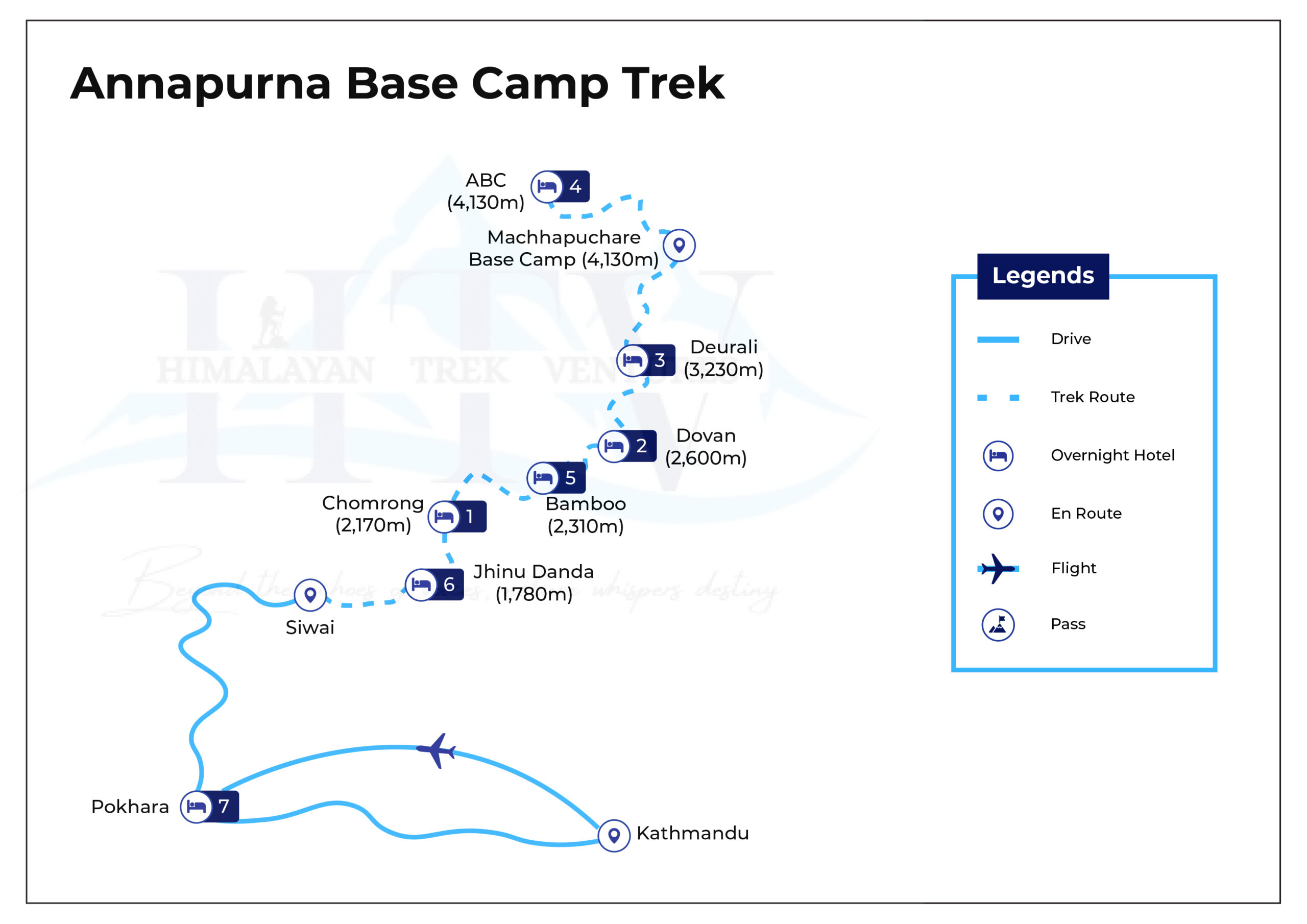
Trip Map
How Safe Is the Annapurna Base Camp Trek in 7 Days?
The 7-day Annapurna Base Camp trek is considered safe for prepared trekkers, but it is not a slow-acclimatization itinerary. Safety on this route depends on understanding how altitude is gained;and how quickly it is released.
The trek climbs from 2,170 m on Day 1 to 4,130 m on Day 4, with the most pressure concentrated on Days 3 and 4. Day 3 gains around 600-700 m, and Day 4 adds another 930 m, which exceeds conservative acclimatization guidelines. This is the point where altitude begins to feel real for many trekkers.
Because there are no rest or acclimatization days, professional operators rely on controlled pacing, early starts, hydration discipline, and constant health monitoring. Oxygen levels drop from about 70% at Deurali (3,200 m) to 60% at Annapurna Base Camp, so guides closely watch for headaches, nausea, sleep disruption, or unusual fatigue during this phase.
The key safety advantage of the 7-day itinerary is the immediate descent. On Day 5, trekkers drop 1,820 m to Bamboo in a single day. This rapid loss of altitude usually brings fast symptom relief, better sleep, and recovery.
In practical terms, the trek is safe when ascent is controlled and descent is respected. It is not risky by design;but it does demand awareness, discipline, and experienced supervision specific to this compressed route.
Packing List for the 7-Day Annapurna Base Camp Trek
This is a teahouse trek, so the focus is on light packing with enough warmth for cold nights at 4,130 m and long walking days. You don’t need camping or technical gear; just a balanced layering system and a few essentials.
Clothing (Layered System)
- Base layers: 2 thermal tops, 1-2 thermal bottoms, 3-4 quick-dry T-shirts
- Insulation: 1 fleece, 1 lightweight down or synthetic jacket
- Outer shell: Waterproof jacket with hood, waterproof trousers
- Trekking wear: 1-2 trekking pants, optional shorts
- Head & hands: Warm beanie, sun cap, neck buff, liner gloves, insulated gloves
- Socks: 3 trekking pairs, 1 thick sleeping pair
Footwear
- Broken-in trekking boots or sturdy trail shoes
- Light sandals or camp shoes for evenings
Sleeping & Teahouse Comfort
- Sleeping bag rated to around -10°C
- Microfiber towel, earplugs, eye mask
Packs & Essentials
- 40-50 L backpack (or duffel if using a porter)
- 20-30 L daypack, rain covers, dry bags
Health, Documents & Extras
- Water bottles (2-3 L) + water treatment
- Trekking poles, headlamp, power bank
- Personal medicines, basic first-aid items
- Sunscreen, lip balm, sunglasses
- Passport, permits, insurance copy, cash
Best Time to Do the 7-Day Annapurna Base Camp Trek
Because the 7-day Annapurna Base Camp trek follows a compressed schedule with rapid altitude gain, timing matters more here than on longer itineraries. You need stable weather, clear skies, and minimal risk windows;there is little room for delays.
October is the best and safest month for this short trek. Post-monsoon air is clear, trails are dry, and avalanche risk in the Hinku Cave-Deurali section is minimal. Daylight hours are sufficient, temperatures are manageable, and visibility is at its annual peak;ideal for demanding Days 3 and 4.
Late September (after mid-month) and early November are strong alternatives. Conditions remain stable, crowds are lighter than in October, but colder nights and shorter daylight begin to matter in November.
April works well as a secondary option. Days are warmer, and rhododendrons bloom, but afternoon cloud buildup and moderate avalanche risk require early starts and experienced guides.
Avoid monsoon (June-August) due to landslides, poor visibility, and delays, and winter (January-February) due to extreme cold, snow, and high avalanche risk;conditions that don’t suit a tight 7-day schedule.
Permits Required for the 7-Day Annapurna Base Camp Trek
This 7-day Annapurna Base Camp trek requires only one permit in 2025: the Annapurna Conservation Area Permit (ACAP). No additional trekking permits are needed for the standard ABC route via Chhomrong and the Modi Khola valley.
The ACAP permit is mandatory for all trekkers, regardless of nationality or whether a guide is used. The current cost is NPR 3,000 for foreign nationals, NPR 1,000 for SAARC nationals, and NPR 300 for Nepali citizens. It remains valid for the full duration of the trek with no time restrictions once issued.
The previously required TIMS card is no longer required, having been officially discontinued in 2023. No restricted area permits apply to this itinerary.
Permits are typically arranged in Pokhara, the main logistics base for this trek, before heading toward the trailhead. ACAP checks occur along the route, especially around Chhomrong.
All permits are arranged before the trek begins, so you can focus entirely on the journey.
Food and Accommodation During Short Annapurna Base Camp Trek
Food and accommodation on the 7-day Annapurna Base Camp trek are simple, consistent, and designed for function rather than comfort. This route is fully supported by teahouses, so no camping is required, but facilities become increasingly basic as the altitude increases toward Annapurna Base Camp.
In Chhomrong (2,170 m), lodges are the most comfortable on the route, with twin rooms, foam mattresses, paid hot showers, charging points, and relatively reliable Wi-Fi. As the trail climbs through Dovan and the Himalaya area, rooms become smaller and simpler, heating is limited to evening dining rooms, and bathrooms are shared.
At Deurali, Machapuchare Base Camp, and ABC, accommodation is very basic. Rooms are uninsulated, often shared in high season, and nights are cold. Hot showers are rare or unavailable, electricity is solar-based, and charging or Wi-Fi, if available, is expensive and unreliable.
Food throughout the trek is hot, filling, and predictable. Dal bhat is the most dependable meal, supported by noodles, rice dishes, soups, eggs, and simple breakfasts. Menus become smaller, and prices rise with altitude, but regular hot meals are always available.
Dates of Trip
$849Save $100
March 1, 2026 - March 7, 2026
$849Save $100
March 3, 2026 - March 9, 2026
$849Save $100
March 5, 2026 - March 11, 2026
$849Save $100
March 7, 2026 - March 13, 2026
$849Save $100
March 9, 2026 - March 15, 2026
$849Save $100
March 11, 2026 - March 17, 2026