Nepal
Moderate
5,416m at Thorong La Pass


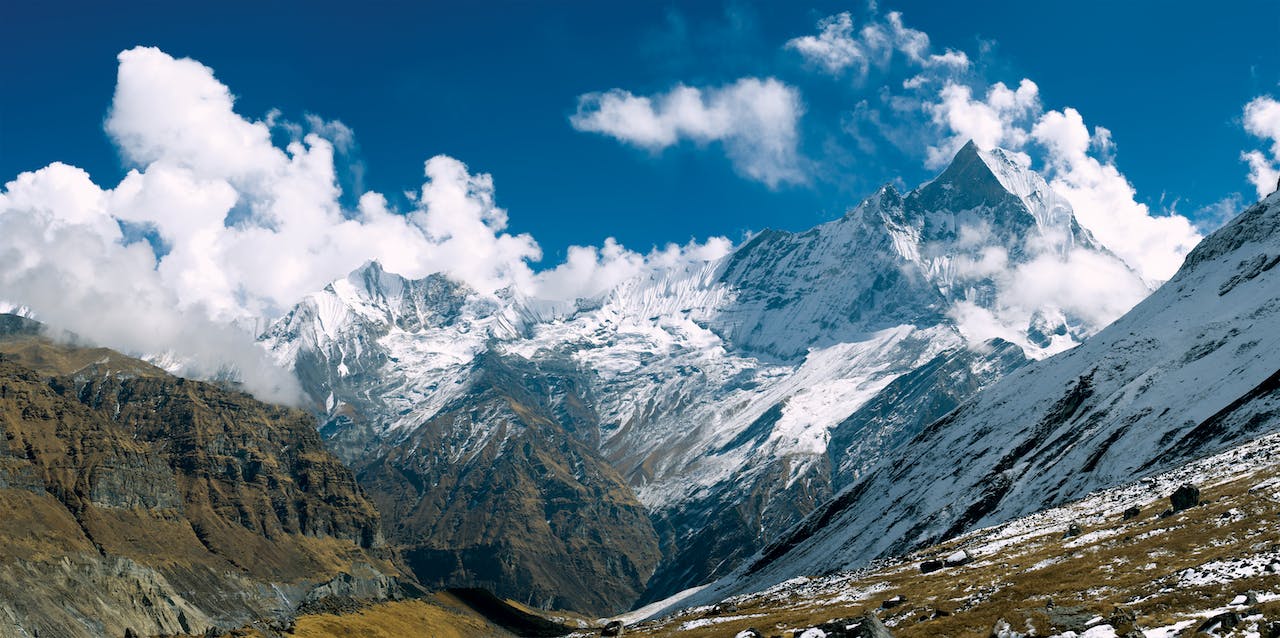
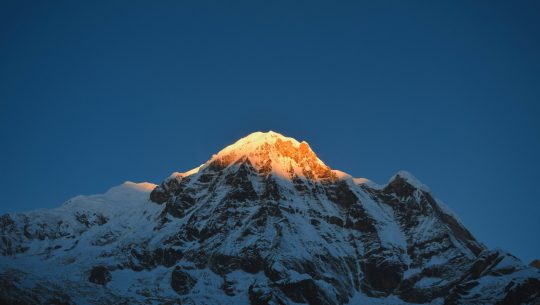
When you enter Pokhara, the 10th-highest mountain in the world, Annapurna I (8,091 m), welcomes you. Guess the name of the region you are entering? Of course, the Annapurna Region.
This Himalayan region in itself is a part of the Gandaki province in the north-central part of Nepal. With a total area of 7,629 square kilometers, it homes both the Annapurna Himalaya Range and the biggest protected area of Nepal, i.e, Annapurna Conservation Area (ACA).
But that’s not it, inside this region fall the naturally gifted Kaski, Lamjung, and Myagdi districts. Just imagine, the beauty of a neighbourhood whose starting point is in Pokhara.
In fact, the whole valley is blessed with natural greenery and some really dry places. Furthermore, it also hosts the Kali Gandaki River, which forms one of the deepest gorges in the world by flowing right through the gigantic Annapurna and Dhaulagiri mountains.
Now, we hope you are intrigued. So, let’s see what the Annapurna region offers one by one:
The whole mountainous area of the Annapurna region is known as the Annapurna massif, which is roughly around 55 km long.
In fact, the whole region is surrounded by natural miracles. In the west, there is the Kali Gandaki gorge; meanwhile, in the north and east, you can see the flowing Marshyangdi River. Additionally, in the south, you will find our starting point, Pokhara Valley.
Wait, the beauty doesn’t end here. Inside the Annapura region lies one mountain over 8,000 meters, thirteen peaks that’re over 7,000 meters, and sixteen mountains that’re over 6,000 meters.
Short and surrounded by nature, travelling in the region sounds dreamy, right? But don’t let it fool you, trekking here means you have to face the difficulties of steep ridges, glaciers, alpine slopes, dense forests, and terraced hillsides.
In fact, historically, Annapurna I is known as one of the mountains with the highest fatality rate in Nepal. Additionally, many trekkers even find it difficult to reach destinations like Annapurna Base Camp and Annapurna Sanctuary.
Besides that, there is Macchapuchre, or popularly known as Fish-Tail mountain, which holds such a religious importance that summiting it has been completely prohibited.
But hey, these difficulties are the reasons that make our journey truly wonderful, right?
Here are some of the popular mountains that the Annapurna Massif hosts:
| Mountain Name | Elevation (m) |
| Annapurna I | 8,091 m |
| Annapurna II | 7,937 m |
| Annapurna III | 7,555 m |
| Annapurna IV | 7,525 m |
| Gangapurna | 7,455 m |
| Machhapuchhre (Fishtail) | 6,993 m |
The other beautiful part about this whole valley is the rivers and lakes, each flowing with its own unique nature.
And while talking about the lakes, one can’t miss out the Tilicho Lake, sitting calmly at an altitude of 4,919m. The highest lake of Nepal is the meeting point of Annapurna I and Tilicho Peak’s melted glacier.
When the crystal clear water mirrors the surrounding mountains of the Annapurna Massif, it truly looks heavenly. We think that’s the region behind its mention in ancient Hindu scripture like the Ramayana.
Besides Tilicho, here are the other popular lakes in the Annapurna region:
| Lake Name | Approx. Area (hectares) | Approx. Area (sq km) |
| Gangapurna Lake | 21.08 | 0.2108 |
| Kapuche Lake | 12 | 0.12 |
| Kamal Pokhari (near Annapurna Sanctuary) | 2-3 | 0.02-0.03 |
| Mardi Lake | 1-2 | 0.01-0.02 |
| Dhampus Lake | 1 | 0.01 |
However, the honest fact is that lakes aren’t the only thing that dominates this valley. The other half that dominates this region is the rivers.
Now, we already have a brief idea about the Kali Gandaki river, but what you mightn’t know is that it actually originates from Tibet, and within Nepal, it covers a total area of 202 km.
And guess what! The deepest gorge of the Kali Gandaki River actually contains fossils from the Tethys Sea that date back to 60 million years.
Beyond that, there is the Marsyangdi River, another one originating from the Annapurna Massif. It has gained its popularity among travelers for white water rafting. But among locals, this holds great value as it provides water for agriculture and daily needs.
Similar to Maryangdi is the 50 km long Modi River, the one that provides for the villages like Ghandruk and Chhomrang.
Besides these rivers, here are some other popular rivers in the Annapurna region:
| River Name | Approx. Basin Area (sq km) |
| Seti River (Budhi Gandaki) | 2,000 sq km |
| Madi River | 763 sq km |
| Rati Khola | 30 sq km |
| Pati Khola | 25 sq km |
| Bhurangdi Khola | 20 sq km |
Now, guess what, the whole rivers and lakes of the Annapurna region come under the Annapurna Conservation Area, which was established in 1986 and covers 7,629 square kilometers, making it Nepal’s largest protected area.
In fact, the whole idea behind the creation of this area was to balance tourism with nature and to help the local people benefit from visitors while protecting the environment.
But here is something that’s even more amazing: inside this area live more than 120,000 residents across 55 villages, representing the ethnic groups and traditions. So yeah, you can quench your thirst for cultural exploration here.
Additionally, this is also the valley where nature lives as it is home to a wide range of wildlife which includes more than 100 species of mammals, 500+ species of birds, and over 1,000 types of plants.
If you are lucky, you might even hear about sightings of the rare snow leopard in higher altitudes.
What makes this region even more special is its people. The Annapurna region is mainly inhabited by Gurung, Thakali, Magar, and Manangi communities. They are known for their warm hospitality and deep connection to the mountains.
Most villages here still follow a traditional way of living; stone houses, wooden balconies, prayer flags, and fields of buckwheat or barley.
You can find both Buddhist monasteries and Hindu temples, which shows how harmoniously both religions have existed side by side for centuries.
If you ever visit Ghandruk or Marpha, don’t miss the chance to try a Thakali meal: rice, lentils, greens, and local pickles served with homemade ghee. It’s simple yet one of the most loved cuisines in Nepal.
Although the Annapurna region is famous for trekking, there’s much more to do even if you are not hiking.
You can start from Pokhara, a city known for its peaceful lakes, lively streets, and mountain views from almost every corner. Visit Sarangkot Viewpoint early in the morning to see the first light touch the peaks. Stop by the World Peace Pagoda for a quiet sunset overlooking Phewa Lake.
If you want to explore higher areas by road, you can take a jeep ride to Jomsom, Marpha, or Muktinath.
In fact, Muktinath (3,800 m) is one of the most sacred temples in Nepal, respected by both Hindus and Buddhists. The nearby village of Marpha is known for its apple orchards and traditional Thakali houses.
Here, every visitor finds something to enjoy. You can go paragliding in Pokhara, take an ultralight flight above the valley, or simply rent a boat on Phewa Lake and relax.
For those who love nature, birdwatching, village walks, and short hikes around Dhampus or Australian Camp are perfect.
Adventure lovers can try white-water rafting in the Seti or Kali Gandaki River. And if you enjoy culture, spending a night in a local homestay is one of the best ways to understand daily life in the mountains.
The Annapurna region can be visited throughout the year, but the best seasons are spring (March–May) and autumn (September–November).
In spring, the forests are covered with blooming rhododendrons, and the skies are clear.
Meanwhile, autumn offers the best visibility and pleasant weather.
However, winter is cold in higher areas but comfortable in lower valleys like Pokhara. The monsoon season (June–August) brings the greenery all around, but also rain and clouds.
To visit the region, travelers need the Annapurna Conservation Area Permit (ACAP) and a TIMS card (Trekkers’ Information Management System).
Pokhara is the starting point, only about 200 km from Kathmandu. You can reach it by a 25-minute flight or a 6-7 hour drive. From Pokhara, roads and flights connect you to Jomsom, Manang, and Mustang.
At Himalayan Trek Ventures, we organize packages in the Annapurna region safely and professionally. Our team is extremely experienced in running the Annapurna campaign.